Tools for Teachers, Critique for All

A Conversation with the Teaching & Learning Lab Faculty Fellows, Fall 2025
During the 2025 Fall term, Teaching & Learning Lab Fellows Tyanna Buie (Associate Professor / Graduate Program Director of Printmaking) and Sejin Hwang (Critic, Industrial Design) hosted a series of events and developed conversation frameworks around more equitable and inclusive forms of critique in art and design education. At the end of the term, Tyanna and Sejin reflected on the conversations around critique with faculty and students and shared takeaways from their workshops. You can read the conversation below.
Facilitator: Dimitris C. Papadopoulos, Senior Instructional Designer, Teaching & Learning Lab / Academic Affairs
Participants: Tyanna Buie, Associate Professor / Graduate Program Director of Printmaking
Sejin Hwang Critic, Industrial Design.
Date: November 14, 2025
Parts of the transcribed text have been edited for length and clarity.
Introductions & Interest in Critique
Sejin Hwang: I'm Sejin. It's my third year teaching at RISD, but I was also a student here, undergrad in Industrial Design. I was really into this design and educational model through ID. Then, I continued my Master's in England related to critique. That's how I taught this course that I'm teaching right now, which is about critique. So, I'm currently teaching students about critiquing the critique. It is an explorative practice, making a space for students to be a little critical and analytical about their critique experience and making tools to enhance the experience. Other than teaching, I’m working as a design researcher, doing strategy and research around design.
Tyanna Buie: I'm Tyanna Buie. I am an Associate Professor in Printmaking, also in my third year at RISD. I was born and raised in the Midwest, am new to the Northeast, and have been teaching at AICAD institutions for a huge bulk of my teaching career. I'm currently teaching screen printing courses, but also Printmaking and Politics, a protest course, which is one of the courses that I was able to bring here to RISD. I'm also [serving as] the GPD, the Graduate Program Director. And there's other courses down the pipeline that I'd like to teach. More exploratory printmaking courses, or experimental courses outside of the traditional.
Tyanna Buie: As somebody who went to art school, of course, and actually didn't go to an art specific school, but being an art major and studying art, critique is a huge part of the way we get through the process and how we get through the work. I've had amazing critiques and I've also had critiques that were challenging. And I also had critiques that I left and I questioned a lot of things: questioned myself, questioned the instructors, questioned my colleagues. But ultimately as educators, we know, especially in the arts, how important critique is. To have an actual conversation directly tied to critique, I think is super important. And I'm also hearing a lot of the same patterns through teaching for so long, from students about how they're concerned about what happens in critique or how they left critique feeling sad, anxious, or depressed. And that is very problematic to me as an educator. I don't want that for anyone. So, the conversation around critique, I think, just had to be had.
Sejin Hwang: My curiosity around critique or thoughts around critique were from my experience as a student at RISD. I think RISD also has its own unique style of operating critique. So that really got me thinking deeply about critique. In Industrial Design, we had some classes talking about structural intervention. And then, at that point I was thinking about critique style. We pretty much stay the same in this traditional format that is from way, way before. Why are we not really changing the structure and why are we keeping this format? So I personally saw a lot of potential in this topic. That's when I wanted to study more about it. And then in my graduate studies, I was able to talk to other art institutions and they were actually having similar problems. So, that was something I got into. Maybe this is a really important space for us to talk to students and faculty, then find ways to try different approaches and strategies in this critique space that we kept the same for several decades.
What is Critique for?
I think it's one way to maybe understand what you're doing and once you can put it out there, outside of it being in the tunnel of your space, once you go public with it, the critique time is the time to really have a bigger world view understanding of what you put out there.
Tyanna Buie: I would say it's to learn about the thing you're doing. I think it's one way to maybe understand what you're doing and once you can put it out there, outside of it being in the tunnel of your space, once you go public with it, the critique time is the time to really get a bigger world-view understanding of what you put out there. And it does help you, hopefully, kind of divorce yourself from your own notions and biases that's in your work and put it out there and see how other people can interact with it.
Because once it's out there in the world, it's in the world now. It's almost like it belongs to the world. So it's important, I think, to get a perspective beyond your own, and it does help push your practice. And this is the hope. The hope of critique is that that's what it's doing.
Sejin Hwang: I usually call critique a tool for iteration. When I'm working with students or professionals, sometimes critique is like a final presentation. The end point of a project or any practices that you're doing. But I understand critique more as a midpoint where you get feedback for improvement, not an evaluation. Critique is a really, really important stage where you get to hear others’ perspectives and also make your work stand alone without you deeply attached to it. Right? So then, you will be able to get valuable and practical feedback from those with fresh eyes. It is an essential step to take before moving on and enhancing the quality of work. So, most of our creative practices take an iterative process, and critique is the core part of it. I always tell my students, and also myself, that critique is just a tool for iteration, not the final evaluation.
Tyanna Buie: It also helps with blind spots, right? Which we all have and you're always going to have them. And it does teach you that you don't know everything. And that it's okay if you don't have the answer for everything.
Sejin Hwang: Because then, you know that there are certain questions existing and then you can take your own time to reflect on it and find the answers to those questions. And that's another step of improving your work.
What should critique feel like?
It's not only the instructor, but I think it's a collective responsibility to make that space together, understanding each other and then what it means to be safe and comfortable for individuals in the room.
Tyanna Buie: I guess for me it would be 'empowered.' I say that because I just think the best critiques are usually the ones where there's this synergy in the room with everyone. We are all vibing together. And you can look at someone's piece and say this thing and the person receives it in a way that goes, actually makes sense. And then we could talk about it. Or they go, 'I don't know why I did that'. And then we talk about it, but not in a way that hurts the individual or makes them feel like they did something wrong or makes them feel like it should be better. It's not about those things. It's about let's actually take this piece for what it is and then that person leaves going: 'I didn't consider that. Thank you'.
That I think is the best moment of a critique, when we all can agree. I just remember being in critiques where I put something up and my colleague was like, 'now Tyanna, what happened?' And I'm like, 'you right.' And just that moment of them calling me out in the best way possible of, 'I know this is not typically what you could do.' But I'm like, 'I had a lot of issues' and we were able to talk about it in that kind of way. And not in a way where I got defensive or they got angry at me. They were just like, 'now what happened?' I was like, 'I did everything wrong because I just kept slipping up and I just didn't have patience with myself.' And I think it's a great way to also be honest with yourself.
Sejin Hwang: I agree. I think it's a moment to be honest with yourself. A moment for reflection. Definitely. But I think overall in my class, I want it to be, you know, a space for cooperative conversation. I think some of the creative spaces, they have their own work, and then it's so easy for them to be in a silo. Just with themself and the work. Then sometimes, I see people are a little afraid to talk about their work or get some negative feedback, so they're really tied to their own work without sharing much of their thoughts.
I think a safe environment to have a cooperative conversation is what I imagine critique should be in my classroom. Of course, sometimes, it's hard to get there. Because, you know, people have different attitudes, cultures and ways of sharing thoughts, whether they are talking about their own work or others’ works. So, it's not only the instructor, but it is a collective responsibility that the entire class makes the space together, almost like a friendly agreement. This includes understanding each other and then defining what it means to be safe and comfortable for individuals in the room, and having the right atmosphere and mood for this conversation to happen. I think that's the most important thing that I want to focus on.
Tyanna Buie: Well, that's interesting because in a recent workshop that I had, we brought in psychologist Nicole Barnes, and we were talking about the word 'safe.' And that word has been challenged in the best way that I never considered because she was saying, I don't think we can actually ensure that we can make a space safe for anyone, but we can create a brave space. And I was like, 'Ooh'...,
How do we create a space where students can feel emboldened to say the things and we all model it too as instructors, how do we model that behavior? That (...)this is a space that we can just exist and be brave and say the thing that you would typically not want to say.
Tyanna Buie: I love the deeper part of 'what do we mean by safe?' How do we create a space where students can feel emboldened to say the things. I think we model it too as instructors, how do we model that behavior? That the behavior of this is a space where we can just exist and be brave and say the thing that you would typically not want to say. And I remember, I had to like give a spiel to students before critiquing. I say, I know you guys are friends. You spend a lot of time with each other. And also there's people in here that are not friends and you don't like each other. But you still should be able to have a conversation about the work in a way that's very respectful. And also, you could still break bread after you had a challenging critique because what's a negative critique? I think we start to ask students what they mean by what's negative? What's harsh? And then we can peel back the layers of what that really looks like.
Sejin Hwang: I totally agree with the word 'safe'. That's why I think it's important to have this onboarding phase with students to see what is the expected mood and image of critique. So I think the word 'safe' cannot cover the whole thing, but I love the word 'brave'.
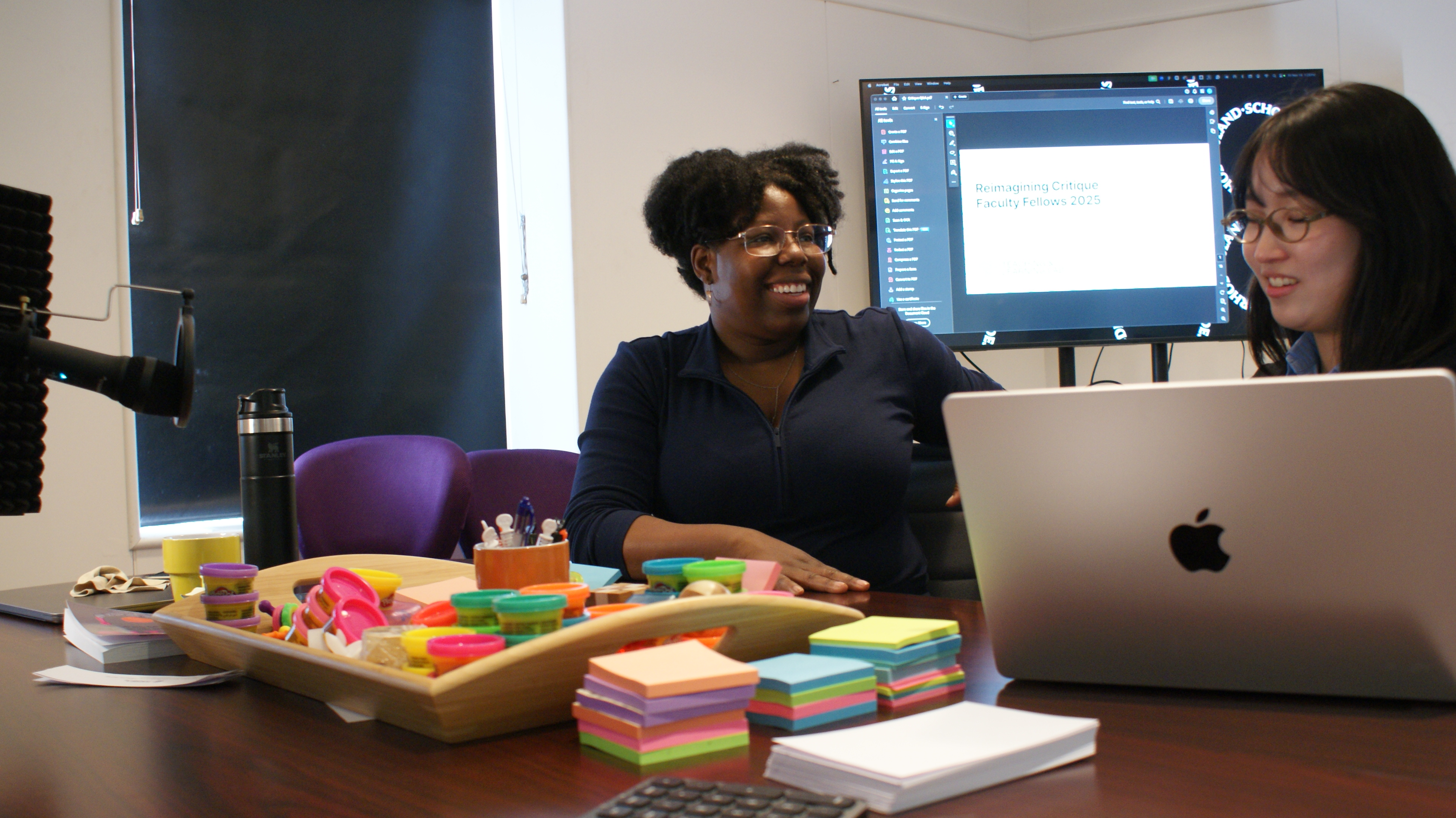
Bringing students into the conversation
My experience as a student was a starting point because I wanted to have this kind of conversation, but I couldn't find any space. (...) What I did was just create a space to talk about this because students already have so many things to talk about. If I just give them a space to talk they're ready for it...
Sejin Hwang: My experience as a student was a starting point because I wanted to have this kind of conversation, but I couldn't find any space like this. When I was studying in grad school, I was finally able to talk about the topic of critique to different people, including students, faculty, recent graduates, and also design professionals. This got me having a foundational understanding of what critique feels like (...). This experience taught me that students already have so many things to talk about regarding critique. They have a good amount of experience from, you know, for RISD, I guess, the first year, they do different practices of sharing ideas and for critique, at least three times per semester. If I just give them a space to talk about their critique experience, they're ready for it. Just in my experience as a student, my studies in grad school, and also my interaction with students.
What students bring into the conversation around ‘critiquing’ is very multifaceted because it's not only related to the conversation we have within the studio space, but it's also related to their identity, culture, value and beliefs.
One interesting element that we discussed in my class was that the current critique experience is limited to creative people. Creative people can be defined in different ways, but in this context, students were referring to people who are familiar with art and design, and the discussions around them. So, some students share that as we often talk to creative people only in the critique space, when they are out in the world, where students meet people from all different sectors, they face challenges in communicating their work.
In the case of product design, some students who graduated or have interned share with me that they had a hard time talking about their work with engineers, as the expected level of understanding or parts for further explanation is a lot different from their critique experience during RISD. Sometimes, the explanation of work needs to be more in detail, walking through step by step of their thought process, as there were some spaces where design students unconsciously expected others would understand. But this can happen with people from many different sectors, not just engineers. So this kind of fruitful experience or thoughts shared by students bring in something very fresh for faculty's perspectives, as well as create a seed for change in our critique structure.
Change takes time (...) But what tools could they get in the meantime? How can the student be in a brave space and have their own way of situating themselves through these critiques?
How do we give our students the tools to just say, 'I don't appreciate the way this critique is going. And here's why'. How do we teach them to do that?
Tyanna Buie: I treated it like a research project because, and also finding a way to try to...how could I creatively solve thisproblem that keeps coming up and I'm hearing? And I think for me, I couldn't fully relate to specific issues because the schools that I went to weren't a part of the umbrella of AICAD, I went to my undergraduate small art department. So the whole school wasn't necessarily art-driven.
So I had to learn how to exist in a space without everybody buying into art already. So I don't remember having challenging critiques, actually. I was, as I was talking to the students that came to me, I had to think back to my experience.But I found a correlation to the issues they were having in critique and to my professional life. So I found a connection, but that still couldn't submit what they were saying. So I was like, well, let me just do my research. And how do you feel about coming in to tell your part of the story? To tell what's your perspective? Because I needed to learn too. So it wasn't just about me doing a workshop for other people, it was more about me. So I selfishly wanted to get a better understanding, which I'm like, and I know if I'm having a challenging time understanding what's really going on (...) I'm sure my colleagues are, and there's other people, but I'm just gonna have to admit it and, and just take one for the team and say, 'I'm also at a loss'. Could you talk to me about what's going on?' And that's how the students got involved because I also just never want to speak for another human. I never wanna speak for a student. And I think that does tend to happen sometimes. We've been teaching for so long that we think we just have an idea of everything all the time.
Dimitris C. Papadopoulos: And that is kind of rare and hard for a teacher. To bring themselves into that vulnerable position of saying, 'I don't actually know. And could you share'?
Tyanna Buie: Especially, being African American and the student coming to me is African American and wanting and telling me their perspective based on the fact that we know how we are, um, perceived in this world. And I was like, wow, that's not been my experience. But let's find a pathway for you, because at the end of the day, I wanna be an advocate for all my students. And so if a student came to me worried about something, regardless of what I, whether I know about it or not, I'm gonna do some research and dig and be like a detective.
That's what bringing the students in was all about that. And I learned a lot in that process and still learning and trying to figure out, working on some, a feedback model or I want to say a takeaway for the students, because I think it would be a missed opportunity to just tell everybody what's happening and say, 'this is the thing and this is wrong'.
But then the students still leave feeling nothing happened. So what can I do in the meantime? Because change takes time, I understand that. But what tools could they get in the meantime? So when they're in a situation where no one is there to say, 'I understand what's happening in this moment'. How can the student be in a brave space and have their own way of situating themselves through these critiques.
For me, it was, it came a little bit natural, more natural when I was in, in art school, when I was in, in college and being in art department, I just automatically knew how to do it. And I think it's just different times. And maybe just because the way that the college culture was. We were expected to speak up for ourselves in that way, where I sometimes see students are having a hard time with that part alone. So it's like, how do we give our students the tools to just say, I don't appreciate the way this critique is going. And here's why. Here's some pathways through this for me. How do we teach them to do that?
Reimagining Critique: Advice for Faculty
My best advice is if a student comes to you, don't blame the student. Don't say, well, you are the problem and you've been having issues in general (...) Make it hard for people to make mistakes but also know they're going to make mistakes and don't punish them for that when your system is not fault tolerant
Tyanna Buie: I think for me, and this was something I presented during my workshop too, was, the the analogy of the airplanes. So the analogy of the airplanes in the, during the World War II, some of the pilots were crashing the planes as they landed, and that's literally never happened before, but it was happening so much. And then other pilots were not having this issue and so they just assumed it was the pilots, clearly, you guys are tired, you're drunk, you're doing something wrong.
So they wanted went into overdrive and spent all this money retraining the pilots and these pilots have been really trying, like in order to get that job, you are a professional, but they're like, something's wrong with these pilots. So they like freak out and over compensate and they were still crashing the planes.
So then they brought in a psychologist who immediately thought the same thing, but then looked at this other and said, let me just go a little deeper, because if they spent all this money and these people are experts in their field, something else must be up. And then they looked at the other planes and saw they were never crashing airplanes, and they just looked at the cockpit and saw there were major differences between one cockpit to the other and the other one cockpit.
The one that they were crashing, the planes they put the things too close together and they couldn't physically tell the difference. So when they would hit the thing to let the wheels go down, the wheels wouldn't go down because they hit the wrong thing And so that psychologist, basically saved aviation because they changed their perspective and said 'let's not blame the person, let's blame the system'.
I think my, my best advice is if a student comes to you, don't blame the student. Don't say, well, you are the problem and you've been having issues in general and.. It's like, I will take that one student and say, what am I doing in the system that I exist in that's not fault tolerant? So the whole point was create a fault tolerant design. Make it hard for people to make mistakes in a sense that, but also know they're going to make mistakes and don't punish them for that when your system is not fault tolerant. I thought that was a very interesting analogy with critique and how we sometimes demonize students who are not fitting in our system. And then one student breaks the fence down
Sejin Hwang: I think, I don't know. I'm also early in my career in teaching, so I would say it for people who are like also new to teaching in general, I would say really come to the Teaching and Learning Lab.
If coming in this institution not knowing anyone I think you need to have, find some office that could help you.
Tyanna Buie: Or mentor, right?
Sejin Hwang: They already have all the resources or any at least like some stories of experiences that happened in the past that would definitely help you. So that's true. I mean, if you see some signals from students, I think talking to the student first is the most important thing, I think.
But at the same time, when you're first time teaching, it's hard to do that, having conversations and, you know, try to really hear from students. That's, that's a hard thing. So find a teaching and learning lab or some of the you know, some of your peers.
Tyanna Buie: I think that goes actually to think about some what student advice will we give. And I think I always tell my students like. ' Be patient. And also you can have a conversation. Know that faculty are not perfect, and you have faculty who also have anxiety issues.' They also have like social, uh, awkwardness. They also don't like confrontation. So you could be coming up against the faculty who has the same personality.' It's ok if you nudge them and say “critique went really awful for me” Can we meet to talk about it?'' Exactly. And so I think teaching is a 360 thing. I don't think I'm teaching you, I think we're all teaching each other. At all times. So give that, so we all should be giving each other grace and patience and understanding.
Sejin Hwang: When students understand that, we can have conversations that challenge the existing hierarchy and create a space where they feel comfortable being honest about their feelings.
Dimitris C. Papadopoulos
December 17, 2025